
Assessing Progress Guide
All day, every day, teachers and support staff are assessing the progress that every child is making across the school. Children's prior learning and understanding informs each lesson that has been carefully planned. Real time, adaptive teaching ensures that teachers can personalise challenges in response to children's progress in each lesson. This is called 'Formative Assessment' as it continually informs teaching and learning.
At the end of the Autumn, Spring and Summer Terms, the progress your child has made is recorded formally. The data entered by Class Teachers is analysed by Senior Leaders and is then discussed at Pupil Progress Meetings, at least three times a year. If Senior Leaders or Class Teachers become concerned that a child is not making the progress we expect, additional support may be used to accelerate learning. Understanding Attainment Years 1 - 6 Your child’s Parent Consultation Record will have a level for Reading, Writing and Mathematics. The example below explains what it means:
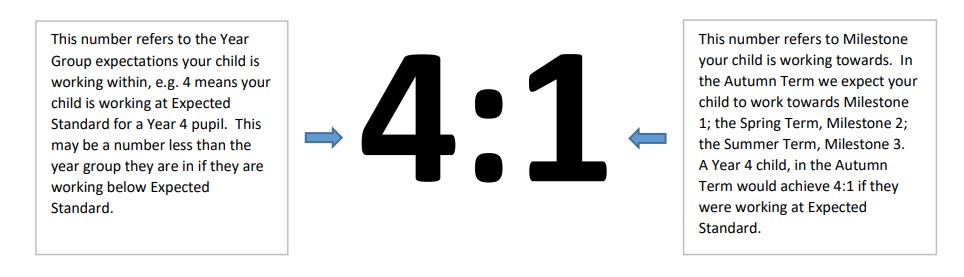
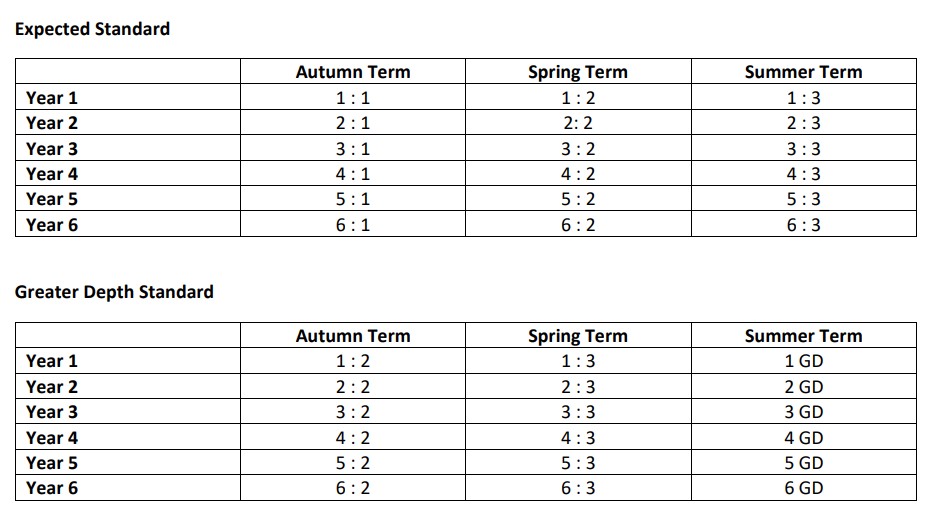
If your child is working towards Greater Depth Standard, the attainment level will indicate the Milestone for the next term, e.g. A child working towards Greater Depth Standard in the Autumn Term would be recorded as 4 : 2. In the Spring Term, they would be recorded as 4 : 3. At the end of the Summer Term, they would achieve 4GD. This confirms they have met the standards for Greater Depth at the end of Year 4. If your child is not working at Expected Standard, the attainment level will indicate the level they are working at. If a Year 4 pupil was recorded as 3 : 2, it indicates they are working at the standard we expect a Year 3 child to be at in the Spring Term.
Understanding Attainment – Reception
Your child’s Parent Consultation Record will have a level for Reading, Writing and Mathematics. The level will be a 1 or 2.
1 – Your child is not on track to achieve a Good Level of Development
2 – Your child is on track to achieve a Good Level of Development
Early Learning Goals
It may be appropriate to use the ELGs to show the progress your child is making. These are the Milestones your child works towards in the Early Years Curriculum.
CAT4 Assessments - Year 5
Completed in Term 3, these GL Assessments provide standardised scores in four different areas: Quantitative, English, Verbal and Spatial Reasoning. The results will support parents in deciding whether the Kent Test is an appropriate assessment for their child to sit. The scores are also useful for the school to use if a pupil is taken to the Headteacher Assessment Panel. The assessments are completed online. Results are shared at the Spring Parent Consultation Evenings (Term 4).
Key Stage 2 SATs - Year 6
This DFE explains the purpose and format of the KS2 SATs. Your child's result will be included with their Year End Report.
Progress in Reading and Mathematics Tests - Years 3-6
To support Teacher Assessments and to track pupils progress, we use GL Assessment's Progress in Mathematics tests and the New Group Reading Test. These assessments are completed in Term 2 and Term 5 for all pupils in Years 3-6. They are completed online and marked instantly, providing teachers and Senior Leaders with standardised scores and a reading age.
A standardised score of 100 indicates an ability inline with age-related expectations. A score of 115 or more suggests a higher ability. Scores lower than 100 highlights an ability that is not yet in line with age-related expectations. Parents are welcome to request results at the end of Term 2 and 5.